
If you’ve ever pulled a CV axle off a lift and wondered why it doesn’t look quite like the last one you replaced, you’re not imagining things. Constant velocity (CV) joints come in several distinct designs, and choosing the wrong one — or misunderstanding why a vehicle uses a particular type — can lead to premature failure, comebacks, and unnecessary NVH (noise, vibration, and harshness) complaints.
TrakMotive’s latest tech bulletin, Understanding the Different Types of CV Joints, lays out the four most common CV joint designs found in today’s vehicles, explains where each one is used, and clears up the difference between 6-ball and 8-ball joint construction. Here’s what every technician, parts pro, and fleet manager should know.
Why CV Joint Type Matters
CV joints transfer torque from the drivetrain to the wheels while accommodating the constantly changing angles created by steering and suspension travel. Different axle positions (inboard vs. outboard), vehicle platforms, and ride heights all demand different joint geometries. Selecting the correct replacement joint isn’t just about fit — it’s about matching articulation angle, plunge length, and NVH performance to the vehicle’s original design intent.
1. Standard Tripod Plunging Joint
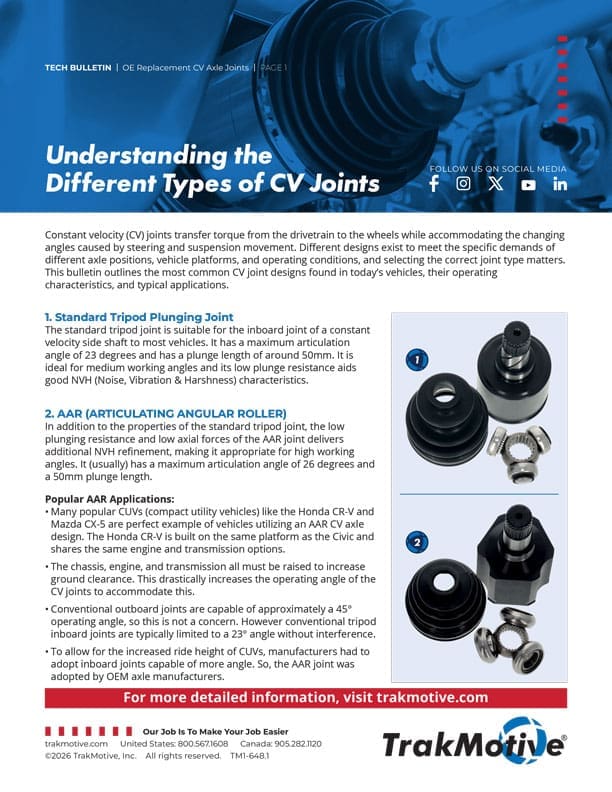
The standard tripod joint is the workhorse inboard joint used on constant velocity side shafts across most vehicles. It offers a maximum articulation angle of about 23 degrees and roughly 50mm of plunge travel. Because it has low plunging resistance, it’s well suited to medium working angles and delivers strong NVH characteristics — a key reason it remains so widely used on the inboard side of the axle.
2. AAR (Articulating Angular Roller) Joint
The AAR joint builds on the tripod design but is engineered for higher working angles. It typically supports up to 26 degrees of articulation with a similar 50mm plunge length, and its low plunging resistance and reduced axial forces give it an extra edge in NVH refinement.
Where you’ll find AAR joints:
- Compact utility vehicles (CUVs) such as the Honda CV-V and Mazda CX-5 commonly use AAR axle designs. The CR-V, for example, shares its platform, engine, and transmission options with the Honda Civic.
- Raising a vehicle’s chassis, engine, and transmission for extra ground clearance significantly increases the operating angle demanded of the CV joints.
Outboard joints can typically handle around 45 degrees, so they aren’t the limiting factor. Conventional tripod inboard joints, however, are usually capped near 23 degrees before interference becomes an issue. - To accommodate the added ride height of CUVs, OEM axle manufacturers adopted the AAR joint on the inboard side, allowing for the extra angle without sacrificing NVH performance.
3. Rzeppa Joint
The Rzeppa joint is the most common outboard joint on front-wheel-drive, all-wheel-drive, and rear-wheel-drive independent suspension vehicles. Since the outboard joint connects directly to the drive wheel, it needs to manage wide steering and suspension articulation angles — something the Rzeppa design handles exceptionally well.
Its construction includes a spherical inner shell with six grooves and a matching enveloping outer shell, with each groove guiding a single ball. A star-shaped steel gear nests inside a spherical cage with six perimeter openings, and that assembly fits into a grooved cup connected to a splined and threaded shaft. Six steel balls sit in the cup grooves and nest into the cage openings alongside the star gear. The output shaft then runs through the wheel bearing and is secured with the axle nut.
4. VL Joint
The VL ball plunging joint is the go-to inboard joint for rear-wheel-drive axles. With a maximum articulation of 22 degrees and 50mm of plunge, it’s built for high working angles combined with low axial forces — an important balance for RWD platforms.
6-Ball vs. 8-Ball Joints: What’s the Difference?
Beyond the four core joint types, ball count is another important spec to understand:
- 6-ball joints are based on the Rzeppa design but use elliptical tracks to confine the six balls instead of a cage. This improves efficiency, and they remain the standard choice for outboard driveshaft joints in modern vehicles.
- 8-ball joints use eight ball bearings instead of six, which lowers the load on each individual ball. That allows each ball to be smaller in diameter, shrinking the overall joint packaging without reducing torque capacity. This makes 8-ball joints especially well suited to lifted trucks and heavy-duty or severe-duty applications.
The Bottom Line
Matching the correct CV joint type to the vehicle isn’t just a spec-sheet detail — it directly affects ride quality, NVH performance, and long-term durability. Whether you’re working on a standard sedan with a tripod inboard joint, a CUV that depends on an AAR joint for extra ride height, or a lifted truck that calls for an 8-ball joint’s added durability, understanding these differences helps ensure the right axle goes on the right vehicle the first time.